Nokia X7-00 Leaked, Runs Symbian^3 has Four Speakers

Another Nokia phone surfaces in the wild, videos and pictures of the unannounced Nokia X7-00 have now leaked online. The report comes from SlashGear, the upcoming Nokia X7-00 runs the Symbian^3 and has four speakers which suggest that it is heavily focused on entertainment.

Features of the phone include a 4-inch screen with a resolution of 360 x 480 (probably a gorilla glass like the Nokia N8). Along with four speakers the Nokia X7-00 has an 8 megapixel camera, 245MB of RAM and 450MB on onboard storage.

Obviously now pricing and availability information is yet available, but check out this video. I feel it is way better than the Nokia N8 and definitely a great device for Nokia fans.

Nokia to push out cheap Windows Phone handsets quickly

Speaking during a meeting with Finnish business journalists, Nokia CEO Stephen Elop said the handset maker would produce inexpensive Windows Phone handsets quickly. The ability to produce smartphones with a very low price point was reportedly on of the key factors in selecting Microsoft as a partner for the future of the Finnish company’s mobile platform. “We have become convinced that we can do that very quickly,” Elop said during this meeting on Friday. The final agreement between Microsoft and Nokia should be inked within the next few months and Windows Phone handsets are expected by the end of the year.

The initial response to Nokia’s decision to drop Symbian and adopt Microsoft Windows Phone has been mixed. The Finnish company’s stock dropped more than 20% and many Finnish employees unhappy with the decision took a voluntary day off when the deal was announced earlier this month. A group of stockholders claimed to be staging a coup to unseat Elop, but this Nokia Plan B initiative was later revealed to be a hoax.

Though many Symbian fans may be disappointed to see their mobile OS of choice disappear, mobile industry executives view the plan as a good move for two companies that are struggling in the mobile marketplace. Nokia is the top manufacturer by volume but is losing marketshare each quarter to Apple’s iPhone and Google’s Android OS. Microsoft is currently on the bottom, trying to fight its way up the ladder. This partnership will give each company a much needed boost.

Nokia CEO Elop also sold all his Microsoft shares on February 17th and purchased 150,000 shares of Nokia. The CEO came under fire earlier this month when it was discovered he held a large amount of Microsoft stock and none in his own company. The battered CEO claimed regulations prevented him from selling this stock during the negotiation period between the two high-profile companies. Now that the deal is public and close to being inked, the former Microsoft executive sold his interest in Microsoft and rightly invested it in Nokia.

Android 3.0 Honeycomb Booting on the HTC EVO 4G

When Android Honeycomb was released it came along with notice from Google that it would be for tablets only. Since it would be opensourced, just like other versions of Android, people could do with it as they wished. They were quick to follow up that Android Ice Cream Sandwich would be coming soon for smartphones which would incorporate all of the improvements realized in Honeycomb.

Shortly thereafter Google released a beta of the Honeycomb SDK -- the tool kit that developers need to write apps (or update existing ones) to work with, and take full advantage of the new OS. Along with the SDK came a Honeycomb emulator.

After some hacking and slashing people in the development community were able to pull out the necessary files and build a bootable version of Honeycomb from the emulator. That's where things get really fun.

Once you've got all the files pulled out, where do you put them? On your smartphone of course! That's just what's been done with the HTC EVO 4G -- and it actually boots, albeit very slowly.

This shouldn't be considered a "final" release by any means. It would be a stretch to even call it an Alpha or "work-in-progress". Not everything works yet, including, but not limited to:
- sdcard
- Music player
- Radios
- Audio
- Camera
- Wi-Fi
- 4G

So, although it might not be wise to go out and flash it today, it's cool to see that others have!

HTC, INQ Mobile Facebook Phones Aim for Social Butterflies

Analysts discuss the viability of INQ Mobile's and HTC's Facebook phones, which seek to improve the Facebook experience for mobile phone users worldwide.
INQ Mobile and HTC made pretty bold bets at Mobile World Congress last week when they introduced what has become to be known as Facebook phones, or handsets that provide super speedy access to the social network.

To be clear, the INQ and HTC handsets won't have the actual Facebook brand and logo on the device. Rather, Facebook's presence is situated on the home screens, with the social network's features and contacts easily available to users.

The INQ Cloud Touch and INQ Cloud Q handsets run Android 2.2 and provide single sign-on and one-touch access to Facebook features. The home screen includes users' Facebook News Feed and links to Chat, Messages, Places and notifications, among other perks.

HTC's ChaCha and Salsa devices run Android 2.3 and go a step further than INQ on the Facebook integration front by offering a dedicated Facebook button to give users one-touch access to their favorite Facebook functions. Among other things, clicking the button allows users to update their status and upload a photo.

Will consumers buy them because of the clear Facebook styling? It's tough to say. INQ Mobile CEO Frank Meehan believes Facebook's 600 million-plus users yearn for these gadgets.

"This audience wants a phone that lives and breathes Facebook, not one that relegates it to a tiny square in the app menu," Meehan told eWEEK in a statement. "We identified this shift in behavior years ago and have been working since then to create devices that use Facebook to drive the communications."

Forrester Research analyst Charles Golvin, meanwhile, called the HTC gadgets desirable because they are competitive Android smartphones that do a better job of integrating Facebook into the overall experience.

"Though it's just a single button, their software design appears to make the action of that button intuitive, across many different phone applications," Golvin said, adding that the ChaCha and Salsa provide "distinction in a sea of faceless Android devices."

Golvin's point is well met. There are well over 100 Android smartphones to date, with more than 300,000 handsets activated each day in 2011.

INQ may be challenged to move its Cloud devices due to its lack of carrier support in the United States, though HTC has reaped the rewards of selling Android handsets such as the Droid Incredible and Evo 4G in the United States.

However, Gartner analyst Ken Dulaney tempered enthusiasm by noting that HTC's Facebook key a secondary issue for most buyers.

"If the phone is great from all other aspects and it has a Facebook key, then it will sell," Dulaney told eWEEK. "I guess it's like a limited edition of a car. Once you get past the collectors, it's about whether the machine is a great car."

And Om Malik, absolutely rebukes the idea of the ChaCha and Salsa as Facebook phones because they lack deep integration with Facebook at the core operating system level.

Even so, both INQ Mobile and HTC expect their respective Facebook-friendly gadgets to drive sales this year.

INQ's Cloud Touch will be available in April at The Carphone Warehouse and Best Buy in the U.K. The INQ Cloud Q will be available in the third quarter from The Carphone Warehouse and Best Buy in the U.K. INQ is mulling a launch in the United States but has no firm plans.

The HTC ChaCha and Salsa will be available to customers across major European and Asian markets during the second quarter of 2011, with AT&T bringing them to the United States later in the year.

Nokia, Samsung Take Top Spots in Good Guide's Green Phone Ranking

With mobile phones becoming ever more ubiquitous around the globe, and taking on many of the tasks previously assigned to personal computers, measuring the environmental impacts of mobiles is an urgent task.

This week, the Good Guide, publishers of detailed rankings of the health, environmental and social impacts of consumer products ranging from pet food to appliances, have added mobile phones to the lists.

The results of the rankings of 596 cell phones from 16 manufacturers, highlight some clear winners and losers, and also showcase how a company's overall performance can and should impact the greenness of a product.

Nokia holds the crown for having the highest-ranking phones -- 26 of the top 30 models are Nokia phones -- most with scores of 7.7 or 7.6 out of a possible 10 points. Also scoring near the top is Samsung's Blue Earth phone, with a perfect 10 on the product environmental score for its energy-efficient charger, use of eco materials, and elimination of brominated flame retardants and PVC.

Nokia's C6 cell phone, which is the overall highest rated product in the list, scored 9.0 on the environmental rankings, but because Nokia as a company performs better on environmental criteria, with 6.5 out of 10 compared to Samsung's 5.8, the phone scored higher overall.

Apple's iPhone fell in the lower-middle of the pack, with a 5.6 ranking for all three iPhones tested. While the product itself scored an 8.5 on environmental criteria -- the company long ago began phasing out toxics from its devices -- Apple the company earned just a 5.0 ranking, in part for its lack of disclosure of other key social and environmental issues.

By far the lowest-ranking company on the list is Research in Motion, whose BlackBerry phones earned a 3.3 rating on average, the lowest of all phones scored. Although its phones in general earn higher scores -- the Bold 9000 smartphone, as an example, scored a 5.0 -- the scores were dragged down by RIM's poor environmental performance. The company scored just .08 on standard environmental performance, for its greenhouse gas commitments and reporting as well as water, waste and air pollution records.

Good Guide was started by Dara O'Rourke, a professor at the University of California, Berkeley, as a way to make it easier for customers to make smart decisions about the products they buy, while they're shopping.

As the company's senior director of business development, Joshua Saunders, wrote on GreenBiz.com last summer:

Here at GoodGuide, we provide millions of consumers with health, environmental and social responsibility information on the products they buy every day. While we provide product and company-level information with the hopes of influencing consumer purchasing behavior, we aren’t directly rewarding consumers who do make greener purchases. A little over six months ago we launched an iPhone barcode scanning app so that consumers can get sustainability information quickly and easily at point of purchase and the app is quickly approaching a half million users.

The full rankings for all 596 cell phones are available online at GoodGuide.com.

BlackBerry App World beats Android and Nokia; Is the Apple App Store unstoppable?

IHS reports state that while Apple is still wiping the floor with the rest of the mobile market in application market sales, BlackBerry is in second place overtaking both Android and Nokia.

While the battle for younger users is between the iPhone and BlackBerry handsets, these figures show that iPhone users buy and download the most applications. Though BlackBerry users in a far away second place downloading even more applications as they become available.

In short, while it does not show a direct correlation between Apple and BlackBerry users and application sales through their respective application stores, it does show Apple’s dominance in the market.
Granted, the Apple App Store is in clear first place with 82% of all revenue, raking in over $1.78 billion in 2010, with BlackBerry taking second place at 7% and $165 million.

Even though Android is the world’s most used mobile operating system, with a staggering 350,000 Android applications per day, it shows that the Android Market is falling behind all the major players - even Nokia.

But crucially, as BlackBerry, Nokia and Android users are year on year buying and downloading more applications, iPhone users are slowing down.

Once Nokia and Microsoft close the deal and the Windows Phone Marketplace and the Ovi Store is combined, this will further dent the figures. Though truth be told, the merger will probably hit the BlackBerry maker Research in Motion more than the Apple.

Is Apple’s App Store unstoppable?

Nokia: Cheap Windows Phones will reach market “very quickly”

Nokia has promised low-cost Windows Phone 7 smartphones “very quickly”, addressing concerns that the Microsoft OS would drive up prices of the Finnish company’s smartphone range. Nokia CEO Stephen Elop confirmed that “we have become convinced that we can do that very quickly” having revealed that one of Microsoft’s key messages throughout negotiations was that Windows Phones could readily hit “a very low price point.”
Mobile World Congress 2011 this past week proved something of a flop for Windows Phone, with new Android devices dominating the line-ups of most manufacturers. Nokia itself has said that its first smartphones running the platform aren’t expected until later in the year, and SlashGear is hearing that carriers are responding negatively to increasing pressure from Microsoft to promote devices.

One of the current issues is pricing, with Microsoft’s stringent minimum specifications and inflexibility on modifications leading to an expensive range of functionally very similar handsets. Broader support for chipsets other than Qualcomm’s will be one important step in that process; earlier this week, ST-Ericsson confirmed it was focusing strongly on the Windows Phone platform.

Technology review : Windows Phone 7

If you’re shopping around for a new smartphone, the choice just got harder. Microsoft has come up with a revamped operating system for mobile phones, Windows Phone 7, and it’s an impressive answer to the current smartphone giants. The new OS was released in Taiwan at the end of last year and is available on two new phones from HTC, the HD7 and Mozart.

Windows Phone 7 couldn’t have arrived any sooner for Microsoft, which has taken a serious beating in the smartphone race over the past four years.

The software giant’s previous platform, Windows Mobile 6, fell into obscurity shortly after the iPhone and Android came out. As a touchscreen OS, Windows Mobile 6 just couldn’t compete with its frustrating keyboard, awkward interface and the lack of a central hub for purchasing apps.

Windows Phone 7 is not an iPhone/Android killer, but it’s shaping up to be a very worthy contender. It does an excellent job on the basics: The touchscreen keyboard works well and the apps for Web browsing, e-mail, music and video are all solid and generally as good as the competition. I tested the Windows Phone 7 on HTC’s HD7, on loan to the Taipei Times from Microsoft, and overall, I found the new OS to be beautifully designed and easy to use.

CAVEATS FIRST

But there are some caveats to consider before rushing out to get a Windows Phone 7 handset.

Power users will have to wait on a few features. Unlike Android and Apple’s iOS, the Windows Phone 7 does not have copy-and-paste functionality for text. There is no multi-tasking for third party apps (although you can listen to the music player while using other apps), nor is there tethering, which allows you to use your phone to connect a laptop or other device to the Internet.

Microsoft says these features will eventually be added (cut and paste is due sometime this year), but if any of the above are essential to you, then your choice is narrowed to the iPhone or Android, both of which have these functions.

There are also glaring inconveniences for Taiwanese users. The interface is not yet available in Chinese, and you can’t type in Chinese in native apps. But Microsoft says to expect an update that will allow everything to be displayed in traditional Chinese characters later this year.

And there is a temporary fix, with several free apps available that have specially designed keyboards on which users can type traditional Chinese characters using zhuyin fuhao (注音符號, commonly known as bopomofo; see sidebar on apps). Unfortunately, there is no free app yet for making Chinese language searches on Bing or Google.

ELEGANT AND SMOOTH

Shortcomings aside, Microsoft did a fantastic job on the Windows Phone 7’s user interface. It feels quite different than the iPhone or Android, but it’s just as intuitive and elegant in its own right.

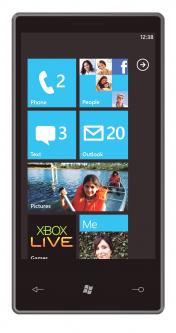
Everything is organized into large “tiles” and “hubs,” arranged on a long vertical home screen.

Think of tiles as oversized icons. They mostly serve to open apps, but they also can link to almost anything you want, whether it’s a single photo, map location, a favorite song or a document. For example, I pinned my shopping list (created with the included note program, OneNote) to the home screen, which made it easy to add to as I remembered things I needed. Just tap, and there was my list, ready to edit.

And the home page is easy to customize — you can put tiles wherever you want. My “shopping” tile went near the top, and I also liked how I could “pin” individual contacts to the home page, which effectively creates a speed dial.

Another nifty feature of tiles is that they show “live” information. For example, if you have a contact on your home screen, it shows that person’s picture and latest status (i.e., Facebook and Windows Live feeds). If you pin the Calendar app to your home screen, the tile shows your next appointment, removing the need to go into the app.

Hubs are tappable tiles, but have a different function. They provide a separate space with multiple pages that brings similar apps and files together.

For example, tap the Games hub and you can view the latest available apps on Microsoft’s Marketplace. Swipe to another page, still within the hub, and you can check on the progress of your games with other players, such as whether it’s your turn or if an online friend invited you to start a game.

Another page shows all of the gaming apps in your collection, and Xbox Live users will find a section devoted to Microsoft’s online games.

There are also hubs for music and video, pictures, Microsoft Office, Marketplace (for downloading and purchasing apps) and contacts (called “People”).

What if you just want to see all of your apps in one place? No problem. Just flick the home page away to the left, and you have another page with all of your apps listed in alphabetical order.

The Windows Phone 7 felt very responsive on the HTC HD7. Flicking and scrolling through apps or pages is as breezy as the iPhone, and the Windows Phone 7’s slick animations produce a “wow” effect of their own. Tap a tile, and everything on the page flutters away before a new app or hub loads.

As far as looks go, the Windows Phone 7 is futuristic compared with the iPhone and Android and their cartoonish icons. It has a minimalist look with a stylish typeface (carried over from Microsoft’s Zune HD portable media player) and bold color schemes.

THE LITTLE THINGS

Microsoft also got a lot of the details right with its Windows Phone 7, from how the phone displays information to contacts and syncing.

On the home screen pages, the screen looks clean and uncluttered, and there’s nothing displayed at the top, except for the time in the top right corner. But what if you want to know how much battery you’ve used? Here’s a slick move: just tap at the very top, and the battery level, WiFi, Bluetooth and phone carrier signal show up, and then disappear from view after a few seconds.

The minimalist approach also works well on the SMS messaging app. Microsoft tweaked the color scheme, layout and fonts just right. I found text message conversations much easier to read and follow than on the iPhone.

Facebook is tightly woven into the Windows Phone 7 in a way that will appeal to avid users. Tap the People hub, and Windows Phone 7’s contacts organizer and your Facebook friends are displayed under a What’s New page, where you can tap on a contact, read their latest status and directly write on their wall. It doesn’t have all the functions of the Facebook app, but it’s a convenient and quick way to keep track of what your friends are posting.

There are also some nice hardware features. The most notable is a physical camera button, a design requirement Microsoft has imposed on manufacturers building the Windows Phone 7 handsets, and for the better.

The button saves time: even if your phone is locked, just hold the button and you go directly to the camera app. With the iPhone you have to unlock, find the camera app, wait for it to boot, and tap the screen to shoot. With a Windows Phone 7 phone, taking a picture happens faster and you’re more likely to capture that decisive moment.

And here’s a feature that might make a few iPhone users envious: Music, videos and photos on the Windows Phone 7 can be synced wirelessly through a WiFi connection.

You do have to jump through a few hoops to make this happen, though. The phone has to be plugged into an AC charger and your PC computer has to be turned on with the Zune Desktop software (Microsoft’s answer to iTunes) running — but once those things are squared away, the feature works well.

I appreciated wireless sync the most when it came to saving photos. I’d go out during the day, snap a few shots, and plug my phone in to recharge when I returned home. And then maybe 10 minutes later, presto, those pictures would show up on my computer.

THE CHALLENGE

I didn’t really miss my iPhone while using the Windows Phone 7 — that is, until I wanted to use certain third-party apps only available on Apple’s iOS platform.

That’s really the challenge right now for Windows Phone 7. Microsoft’s marketplace already offers some very good apps, but with a total of 8,000 apps to date (compared with Apple’s 350,000 and Android’s 200,000), the store still has to play catch-up.

A side note about third-party apps: the Windows Phone 7 can be slow to load apps, especially games. I spent some time playing a fantasy battle game called Assassin’s Creed, and it often took longer than a minute to load.

And for now, the marketplace isn’t fully open to users in Taiwan. We can download free apps, but can’t make purchases, which is discouraging.

But right out of the box, the Windows Phone 7 does the job of a modern touchscreen smartphone very well. If you just want the basics, everything’s already there: Browsing the Web on the mobile version of Internet Explorer is a smooth experience; the music and video app, which is similar to Zune HD, looks fantastic and is easy to use; and the Office hub lets you create Word Docs and edit PowerPoint files. Setting up contacts is painless if you use Windows Live (Googlers will have to take a few extra steps). And Facebook is practically baked into the phone.

Users in Taiwan will probably want to wait until later this year, when Microsoft updates the Windows Phone 7 with Chinese capabilities, but for those seeking a good alternative to the iPhone or the many Android handsets, this is definitely one to consider. The world may not need another smartphone, but too many choices is better than none.

WINDOWS PHONE 7 APPS

Read on for a shortlist of free apps available for the Windows Phone 7

Chinese SMS

For now, the Windows Phone 7 doesn’t have Chinese capabilities, but this app fills the gap, allowing you to write text messages using zhuyin fuhao (aka bopomofo).

Chinese Mail (中文郵件)

Allows you to write e-mails in Chinese using either zhuyin fuhao or hanyu pinyin

Omi Jump

A fun game by Taiwanese developer Bungbungame (戲智科技), in which you play a cute alien that must dodge cute monsters

Facebook

Even though Facebook is well integrated into the Windows Phone 7, the official app is also worth having, and the look matches Microsoft’s stylish theme

YouTube

A must-have app that works smoothly on the Windows Phone 7

WATAHHH!

Throw a punch with your phone (but don’t drop it!) and listen to recorded sound bites of kung fu wisdom from Bruce Lee (李小龍)

Flickr

The popular photo management Web site offers an app that matches the Windows Phone 7’s stylish iconography and look

Mobile World Congress: All Out Competition

Flying back from the Mobile World Congress show, the thing that stands out the most is that mobile remains the most exciting, most competitive, and fastest changing technology market I've ever seen. I well remember the amazing changes and excitement around the birth of the PC market in the early 80s, and the Internet explosion in the late 90s, but this feels even more exciting - in part because the competition is so fierce on so many different levels.

The MWC show fills the Barcelona Fira and attracts about 50,000 attendees. While that's technically only about one-third of the size of the Consumer Electronics Show, the show actually felt more crowded, and I just couldn't see half of what I would have liked to.

Of course, there are lots of different devices, and lots of different device manufactures. There are dozens of makers of mobile phone and tablet makers -- maybe hundreds if you count the small Asian businesses -- and the show was filled with new devices from HTC, LG Electronics, Samsung, and Sony Ericsson - not even counting the ones from HP, Motorola, and Research in Motion before it began.


Walking the show floor, it was easy to get the feeling that Android has won the operating system wars, with most device makers and most chip makers pushing the platform. In part, though, that's because Apple isn't at the show, and doesn't let its competent vendors talk about it.

When I walked into the AppPlanet building, which hosted hundreds of software vendors, I did see a whole lot of applications designed for the iPhone and iPad, as well as many aimed at Android. I wish I had more time there. A number of companies were taking about Windows Mobile, but even the ones who have phones -- such as LG and Samsung -- were promoting Android more. Windows Mobile seems to be competing with Research in Motion's BlackBerry and Playbook; and HP's webOS is competing for third place, at least in the minds of most attendees. Nokia has now orphaned Symbian, and while Intel put on a brave face with MeeGo, and it may have a future in embedded devices, it doesn't look like it's a real player in phones and tablets.

There's huge competition among the chip vendors to make both the application processors and the radios that get into the phones and tablets. Broadcom, Freescale, Intel, Marvell, Nvidia, Qualcomm, Samsung, ST- Ericsson, and TI all showed new or upcoming application processors at the show. Even the basic architecture faces some competition, with the ARM architecture the entrenched player (used in the fast majority of phone and tablet chips today) facing off against Intel coming in from the PC market and MIPS coming in from the network processor market. I'll be posting a lot more about these chips in a bit.

As far as network standards go, most of the market was dominated by the various flavors of 3G, with LTE coming on strong. But there were also a few folks pushing WiMax chips, although since the show is put on by the GSMA (which backs the various GSM standards, including LTE), there wasn't much of that. And, of course, almost every market has multiple carriers, all with various strengths and weaknesses. Syniverse, known for providing roaming and SMS services to carriers, says it works with about 800 mobile operators worldwide and about 100 in North America. Obviously, most of those are relatively small.

On top of all of this, you have the competition for applications with hundreds of thousands now on the market; and for services on top of it, including cloud-based methods of accessing information.

One big question over the next couple of years is where you draw the lines between phones and tablets and PCs, as these mobile devices get even more features. If you count the iPad as a mobile PC, then Apple is suddenly the #1 maker of mobile PCs, according to DisplaySearch. Smartphones now outsell PCs, so if you count those as well, the share of Microsoft Windows and Intel processors ("Wintel") in smart devices has declined significantly just in the past few years.

But more importantly, what we're doing with these devices has changed. We're now connected wherever we go, and are sharing our information with our family, friends, and colleagues while on the move.

It's all pretty amazing, and the most exciting change in technology in a long time. 

Twitter Delicious Facebook Digg Stumbleupon Favorites More

 
Template edit by Sock